
Structured Derivations old
Additions and changes
– video on how to calculate the value of an expression
– video on how to check a calcuation and fix errors
– video on how to solve an equation
– video on how to solve a word problem
– separate pages for calculations, solving equations, solving word problems, etc
– link to tutorials
Structured derivation
Structured derivations is a simple language for writing the solution to a math problem, in a way that is easy to understand both by a student and by a computer. The language shows the logical structure of the solution, and requires that each step in the solution is explicitly justified. Structured derivations give a deeper understanding of how mathematics works, of the logic behind a mathematical solution. It guides the student in how to construct a valid mathematical argument that starts from initial assumptions allowed by the problem statement to a final answer for the problem.
Derivation editor
eMathStudio has a special digital derivation editor for constructing and editing structured derivations. The editor uses standard mathematical notation. It guides the student into constructing a syntactically correct derivation, and preserves the correct syntax during editing. The editor allows the student to write down an initial solution to a problem and then improve the solution incrementally, to find a correct answer to the given problem. The solution is automatically saved so the student can return to it later. A solution can also be shared with others for discussion and help.
Automatic checking
The automatic checker reads a structured derivation step by step and checks the correctness of each step. Steps that are proved correct are marked as such with a check mark, while steps that cannot be proved correct are marked with a question mark. The checker gives the student immediate feedback on his/her own solution when it is most needed, when the student is working on the problem. The solution is correct if the checker has proved each step correct. Otherwise, the student needs to go back to the solution and fix the unproved steps. And then check and fix anew, until the checker says that the solution is correct.
How to solve math problems with structured derivations
The video below shows how these three features work together when solving a (very simple) calculation problem.
A structured calculation
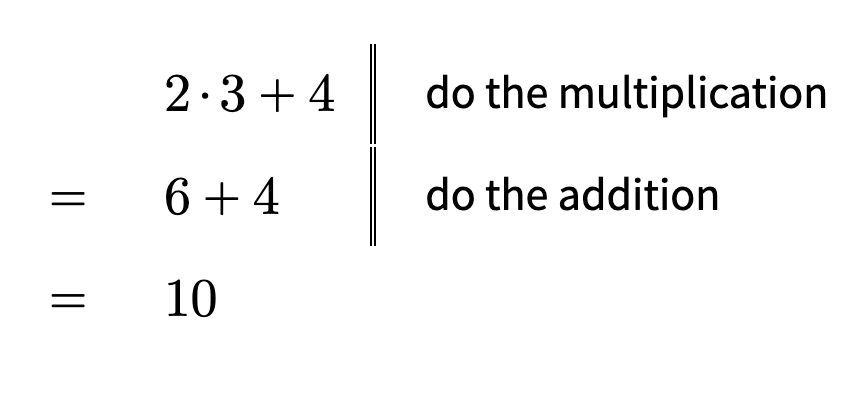
A structured calculation is a simple, but very useful, form of a structured derivation. Below on the left we show a standard calculation, and on the right a structured calculation. The structured calculation describe the same calculation as the standard one, we have only changed the layout a little bit.
Standard calculation
Structured calculation
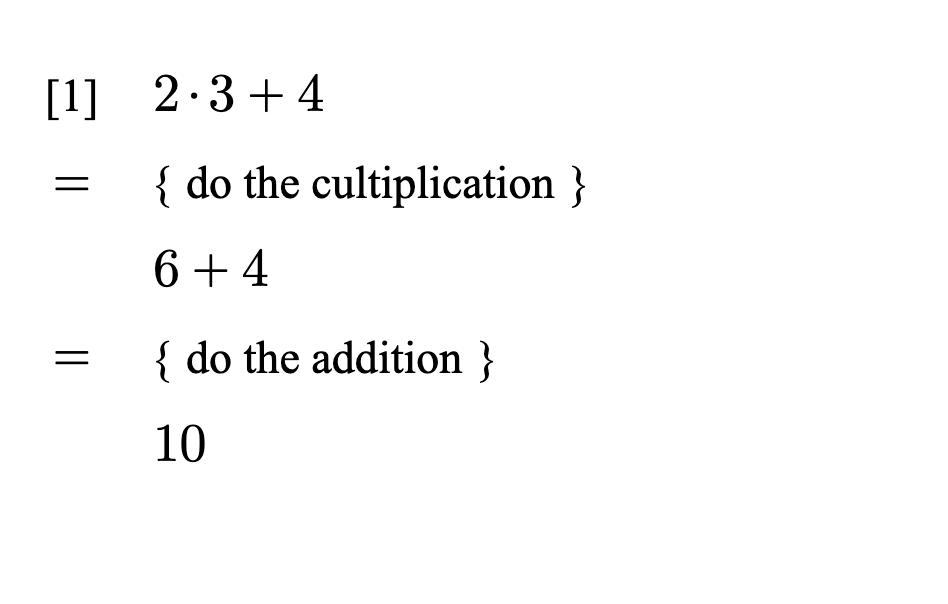
The difference is that
- each expression is written on a line of its own,
- the equal sign is written on a separate line between the expressions, and
- the explanation for the step is written on the same line as the equality sign, inside curly brackets.
The main advantage of this format is that it provides more space for both the expressions and for the explanations/justifications of the calculation steps. The notation emphasises the need to explicitly justify each calculation step, by allocating a full line for the explanation (trivial explanations can be omitted). Both the expression and the explanation can go over multiple lines.This syntax also allows us to construct much more complex calculations when needed, by using nested (auxilliary) calculations, indented one step to the right. .
Construct a correct calculation
We now show how the three main features of structured derivations work together to help us construct a correct solution to a mathematical problem. We choose a very simple example here, to illustrate the technique. The tutorials in eMathStudio give a number of more advanced and challenging example problems and their solutions.
We illustrate the checker by showing how it handles a calculation that has errors. The initial calculation is as follows:
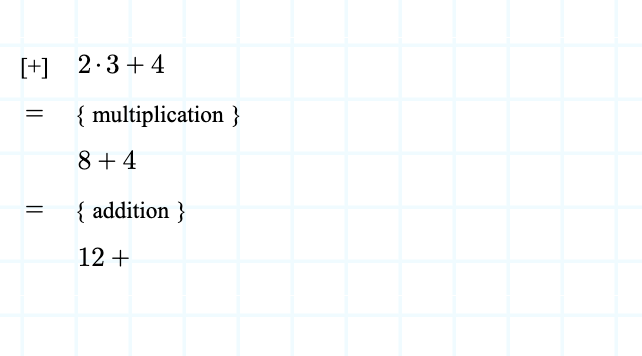
The checker shows that there is an error in the calculation. It is a syntax error, which the checker marks with a red x-sign.
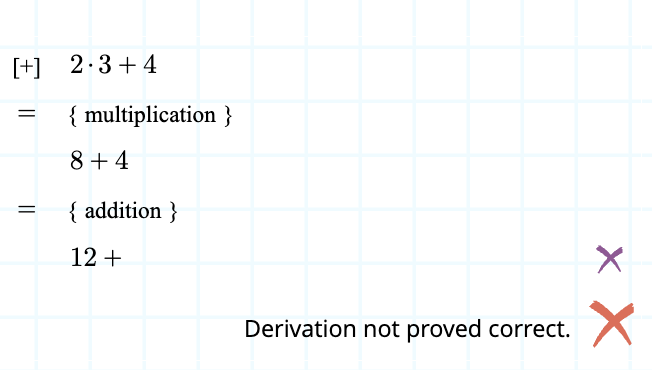
Clicking on the x-mark shows that there is an extra + sign after 12. We remove the extra sign and check again. Now we get the following result.
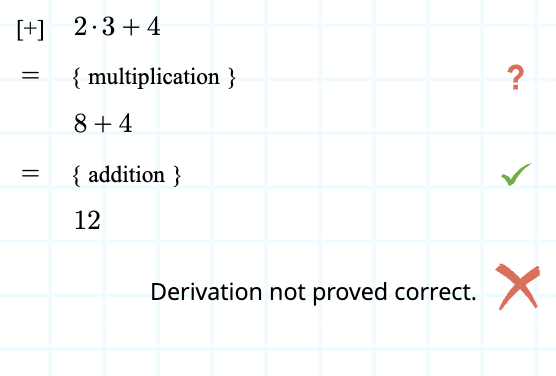
The syntax error is now fixed, but the checker marks the first calculation step as unproved. We notice that there is a calculation error in the first step. We correct this, and check the calculation again. We get the following result:
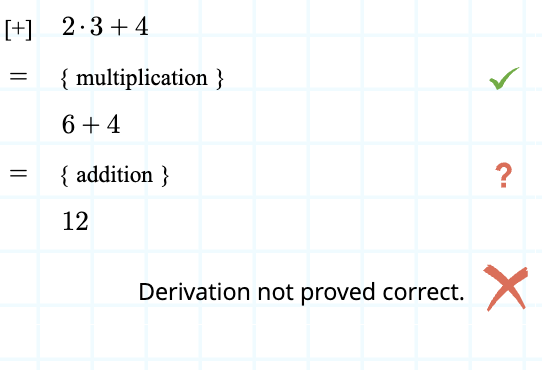
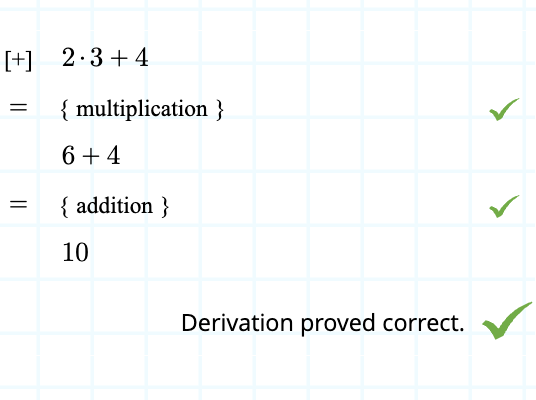
The first step is now correct, but the second step is now marked as unproved. This is because we forgot to update this step. Changing the last expression to 10 gives us our final version, which the checker now marks as correct.
Solve equations
Solve word problems
Check out the tutorials
The best way to learn more on how to solve math problems with structured derivations is to check out the tutorials in eMathStudio. Start with the tutorial Get Started with Structured Derivations to learn the basics (requires no registration or subscription). You can also try out here for yourself how eMathStudio works in practice.
More tutorials
There are a lot of tutorials that you read, to learn more about structured derivations and the eMath method for learning math. Click on the title to learn more.
Get started with structured derivations
How to solve word problems.
General problem solving
Logical calculations
eMathStudio tutorial
eMathStudio tools
Vectors
Trionometry
Calculus
Axiomatic proof
Number theory proofs
Calculaus proofs